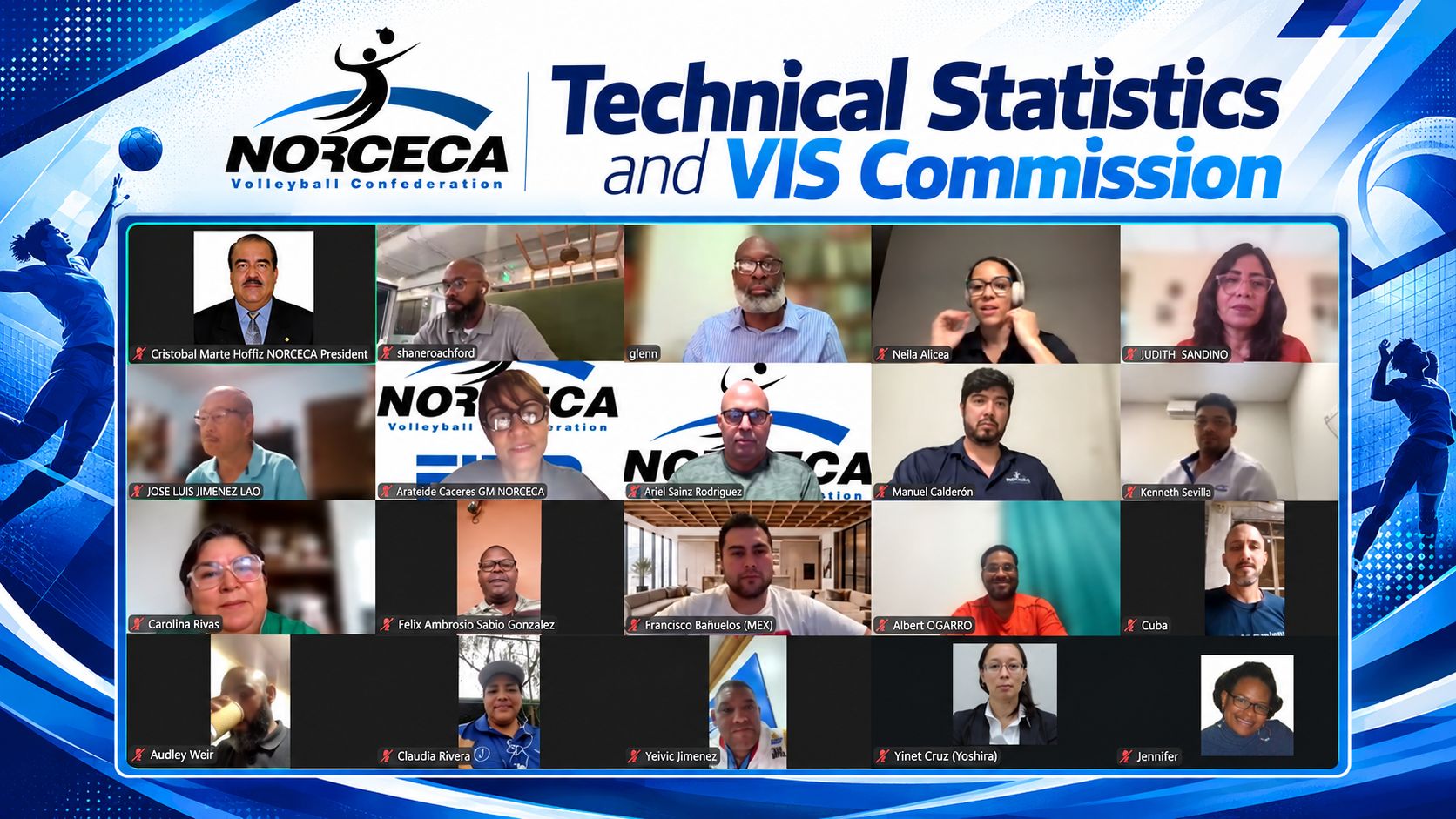
SANTO DOMINGO, Dominican Republic, October 7, 2026.- The NORCECA Technical, Statistics and VIS Commission held its annual virtual meeting to evaluate the implementation of new technological tools during the 2026 season, adaptations to the rules of the game, and operational requirements for the 2027 competitions.
The meeting, chaired by Commission President Judith Sandino, was attended by NORCECA President Cristóbal Marte Hoffiz, Vice President Ariel Sainz, and Commission members, who reviewed progress in statistical management at continental tournaments and the development of technical personnel across the Confederation’s different zones.
In his welcoming remarks, Marte Hoffiz praised the Commission’s performance, describing it as one of NORCECA’s most outstanding commissions. He highlighted the successful completion of its work calendar, the preparation of statistical reports for competitions, and the importance of providing detailed information on players’ performances, contributing to raising the technical standards of events.
Ariel Sainz highlighted the efforts made during a season that included 18 volleyball events, in addition to beach volleyball competitions. He noted that the transition to the VolleyStation system represented one of the main challenges of 2026, requiring new working methods and an adaptation process for Commission members.
Judith Sandino emphasized the importance of maintaining constant communication among members and continuing to align NORCECA’s technical and statistical procedures with the standards of the International Volleyball Federation (FIVB).
One of the main agenda items was the evaluation of modifications implemented in the VolleyStation Pro and VolleyStation Referee platforms in response to rule changes considered during the season.
Commission Secretary Manuel Calderón explained the adaptations made to address specific game situations, including provisions related to team composition, court changes, and substitutions. The Commission also discussed the experience of conducting remote statistical scouting for senior continental competitions from Poland, a practice that could be adopted at future NORCECA events when technical conditions allow.
Looking ahead to 2027, Calderón presented the main requirements for optimizing the operation of the VolleyStation and VolleyStation Referee platforms. Among the priorities, he emphasized the need to ensure dedicated and stable internet connections for communication between scorers, referees, and team benches, along with backup systems in case of service interruptions. The proposals also included maintaining a second scorer to assist with score verification, substitutions, and technical issues.
Regarding statistical operations, he stressed the importance of ensuring a suitable position for scouting and establishing a mandatory score verification procedure between the scorer and the VolleyStation operator before the end of each set, particularly when scoring corrections have been made.
Calderón also presented proposals aimed at strengthening VIS personnel in the AFECAVOL, CAZOVA, and ECVA zones through continued training programs and support from VIS delegates or assistants undergoing development. Other initiatives included evaluating the use of the Starlink system to improve connectivity and the possibility of eliminating printed certificates and M3 forms, as these documents can be verified digitally through the VIS system during pre-competition inspections.
Regarding zonal development, AFECAVOL presented its work in training VIS personnel, with four delegates and seven prospects who have participated in training activities and competitions throughout the zone. The contribution of Honduras’ Javier Lagos was also recognized for his support and remote supervision of the electronic scoresheet.
Marte Hoffiz highlighted the progress achieved in AFECAVOL and ECVA, as well as the need to continue strengthening the training of specialized personnel in CAZOVA, with the aim of expanding technical capabilities throughout the Confederation.
The proposals presented during the meeting will be considered as part of the Commission’s recommendations to the NORCECA Executive Committee and Board of Administration, with the objective of maintaining quality standards and strengthening the technological and statistical management of competitions.
In closing, Sandino acknowledged the commitment of Commission members and reaffirmed the importance of continuing training and technological development to meet the needs of NORCECA’s upcoming events.