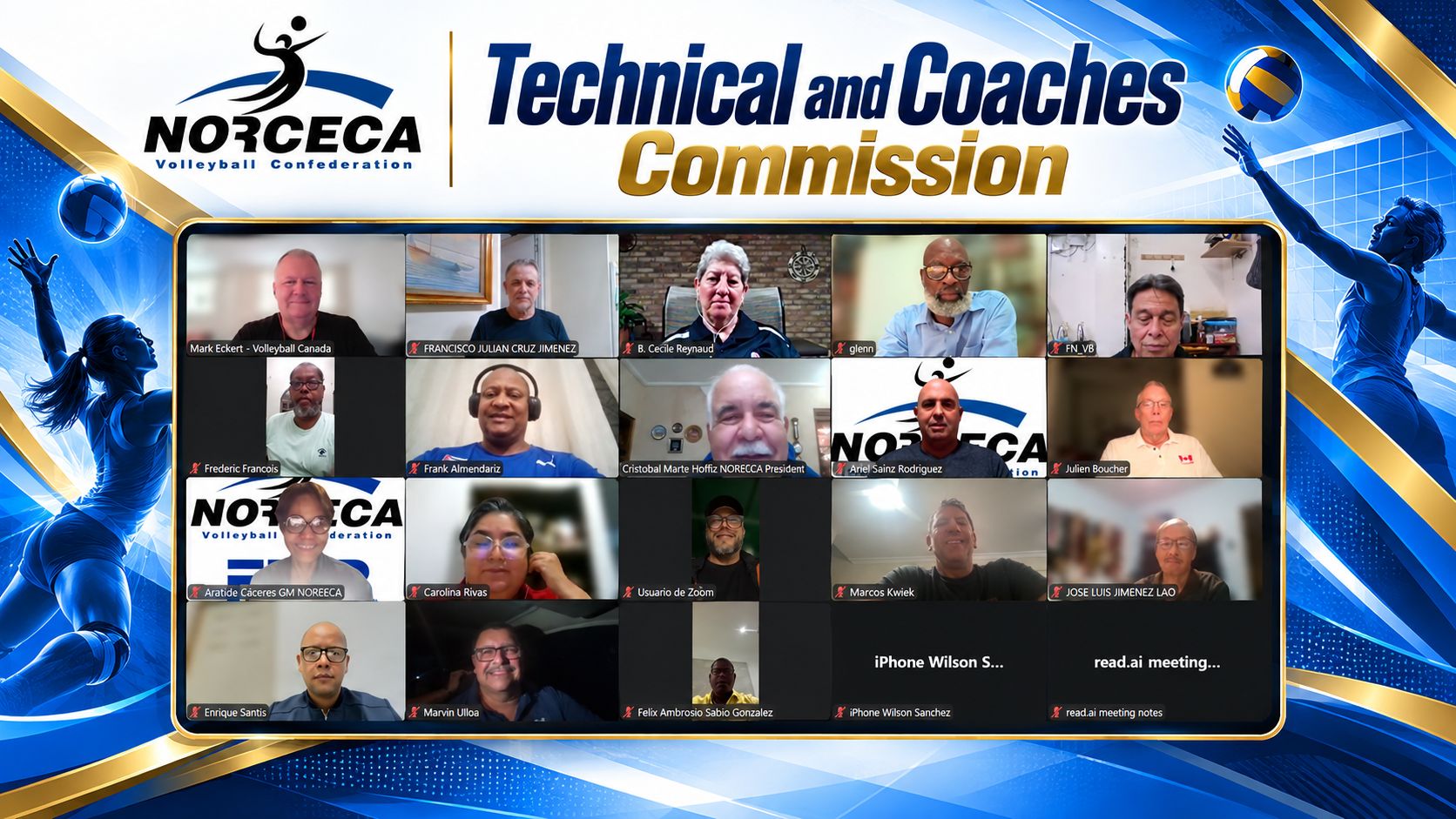
SANTO DOMINGO, Dominican Republic, October 8, 2026.- The NORCECA Technical and Coaches Commission held its annual meeting virtually, addressing the sustainable development of volleyball and beach volleyball, coaches’ education, opportunities through the FIVB Empowerment Program, and the impact of changes to the rules of the game implemented during the 2026 season.
The meeting was chaired by Commission President Francisco Cruz Jiménez, with the participation of NORCECA President Cristóbal Marte Hoffiz, First Executive Vice President Ariel Sainz Rodríguez, and Commission members, who shared experiences and proposals aimed at strengthening the technical programs of National Federations.
In his welcoming remarks, Marte Hoffiz thanked the Commission members for their commitment and dedication, noting that 2026 has been a year of significant changes and challenges for volleyball, particularly with the implementation of new rules of the game.
Sainz Rodríguez emphasized that one of NORCECA’s main challenges is keeping pace with the sport’s evolution. He explained that meetings have been held with coaches throughout the Confederation’s competitions to gather their experiences and assess the impact of the new rules, with the aim of presenting a report reflecting their observations and recommendations at the upcoming FIVB Congress.
One of the main topics of discussion was the relationship between the development of indoor volleyball and beach volleyball. Francisco Cruz presented an analysis highlighting the importance of maintaining a broad player base, considering that many athletes competing in beach volleyball come from indoor programs, where they acquire the sport’s technical fundamentals.
The discussion raised concerns that a decline in the number of indoor volleyball players could limit the pool of athletes available for selection and replacement in beach volleyball, affecting the long-term sustainability of development programs.
However, it was also acknowledged that, for some National Federations, particularly in the Caribbean islands, beach volleyball represents a more accessible alternative due to infrastructure and resource limitations. The example of St. Kitts and Nevis was highlighted, where the lack of indoor volleyball facilities has encouraged the development of beach volleyball programs.
Participants agreed on the importance of finding a balance between both disciplines, taking into account each country’s circumstances and capabilities. They also highlighted the development program being implemented in Haiti with NORCECA’s support, aimed at progressively increasing player participation from the youngest age categories, with a long-term growth outlook.
Regarding coaches’ education, a model for success was presented based on five fundamental abilities: knowledge of the sport, planning, organizing, analysis, and the ability to rethink and adapt to new circumstances.
It was emphasized that these abilities enable coaches to transform information into sound decisions and competitive results. The discussion also stressed the importance of continuous evaluation, maintaining long-term relationships with players, and establishing development programs with sustainable objectives, while recognizing the human and financial resource limitations faced by many Federations.
Another key topic was the FIVB Empowerment Program, presented by Glenn Quinlan, who outlined the support opportunities available to National Federations in three main areas: coaching support, equipment, and knowledge transfer.
Particular emphasis was placed on technical assistance through coaches who can remain in beneficiary countries for periods of three months, six months, one year, or longer, depending on each program’s needs.
The Commission discussed the importance of ensuring that this support helps establish structures capable of sustaining themselves once FIVB assistance concludes. In this regard, the need to work closely with Category I and II National Federations to identify solutions tailored to their specific circumstances was emphasized.
Knowledge transfer was identified as one of the priorities, as it enables Federations to strengthen their technical and administrative capacities and develop programs with greater long-term autonomy.
During his presentation, Ariel Sainz Rodríguez reviewed the implementation of changes to the rules of the game during 2026. He explained that the FIVB announced eleven changes in February for implementation in selected international competitions, ten of which were adopted by NORCECA, with the exception of the provision allowing eight substitutions.
Among the aspects that presented the greatest difficulties were the interpretation of catching and throwing the ball, the increase in the number of substitutions, and changes related to the use of the referee’s whistle.
Sainz Rodríguez noted that the preparation period was too short for players, coaches, and referees to adequately adapt to the new provisions. He also observed that teams with previous experience in the Volleyball Nations League (VNL) had greater opportunities to become familiar with the changes.
In this regard, the importance of recommending longer adaptation periods to the FIVB before implementing further changes was raised, along with the need to consider the experiences and observations gathered during NORCECA competitions.
The Commission also addressed the need to update technical manuals, promote FIVB refresher courses, and strengthen the preparation of coaches and referees to ensure consistent interpretation of the rules.
At the conclusion of the meeting, Francisco Cruz Jiménez thanked participants for their contributions and reiterated the importance of taking advantage of the opportunities offered by the FIVB Empowerment Program, particularly those related to knowledge transfer, as a fundamental tool for strengthening volleyball development within NORCECA’s National Federations.